The free calisthenics level assessment
Find your exact level across all 9 fundamentals.
Answer a few questions about how you push, pull, hold and squat — no equipment, nothing to perform in front of anyone.
You’ll see your level on all 9, the one fundamental holding the rest back, and your exact next move.
Free · about 3 minutes · no app to download
9 fundamentals scored · 100+ progression levels · 4.9★ · 100,000+ trained
“Every other beginner program was always too hard so I’d quit. This one actually started where I was at.” — Angel, TMA member
Updated July 2026
Your calisthenics level is not one number — it is nine.
This free assessment (Bodyweight Training Arena, built with The Movement Athlete) measures all 9 Fundamentals individually: push-ups, pull-ups, dips, handstands, squats, abs, side, back and plank.
- One score hides the gap — most people are levels ahead in one movement, far behind in another.
- Across the 9 Fundamentals there are 100+ progression levels — enough to find your exact starting point, not just a category.
- About 3 minutes, in your browser. No signup to see your result; no equipment beyond a floor for most of it.
When you finish you know exactly which variation matches your ability in each fundamental — and which microprogression to train next. Over 100,000 people have used this assessment-first approach to find their level and start training that day.

The assessment is where it starts — the levels take you the rest of the way.
What does the assessment measure?

The 9 Fundamentals: pushing · pulling · legs · core (abs, side, back) · bodyline. Swipe across on mobile.
Nine foundations. One level each — not one label for all of you. Your push can be miles ahead of your pull; your shoulders can be strong while your hips are locked. A generic “intermediate” tag can’t hold any of that, so this assessment measures each foundation on its own:
- Push — horizontal and vertical. How you press the ground away (push-ups), press your own weight down (dips), and the overhead press that becomes a handstand.
- Pull — rows and pull-ups. The pattern most people are quietly weakest at, because it’s the one they can’t fake at home. Usually where the surprise lives.
- Core — from three angles. The front line (abs), the sides most workouts ignore (side), and the back — the posterior chain that keeps you upright and pain-free.
- Bodyline — the plank. The full-body tension that holds every other movement together.
- Legs — the squat. Lower-body strength and control, from assisted squats toward the pistol.

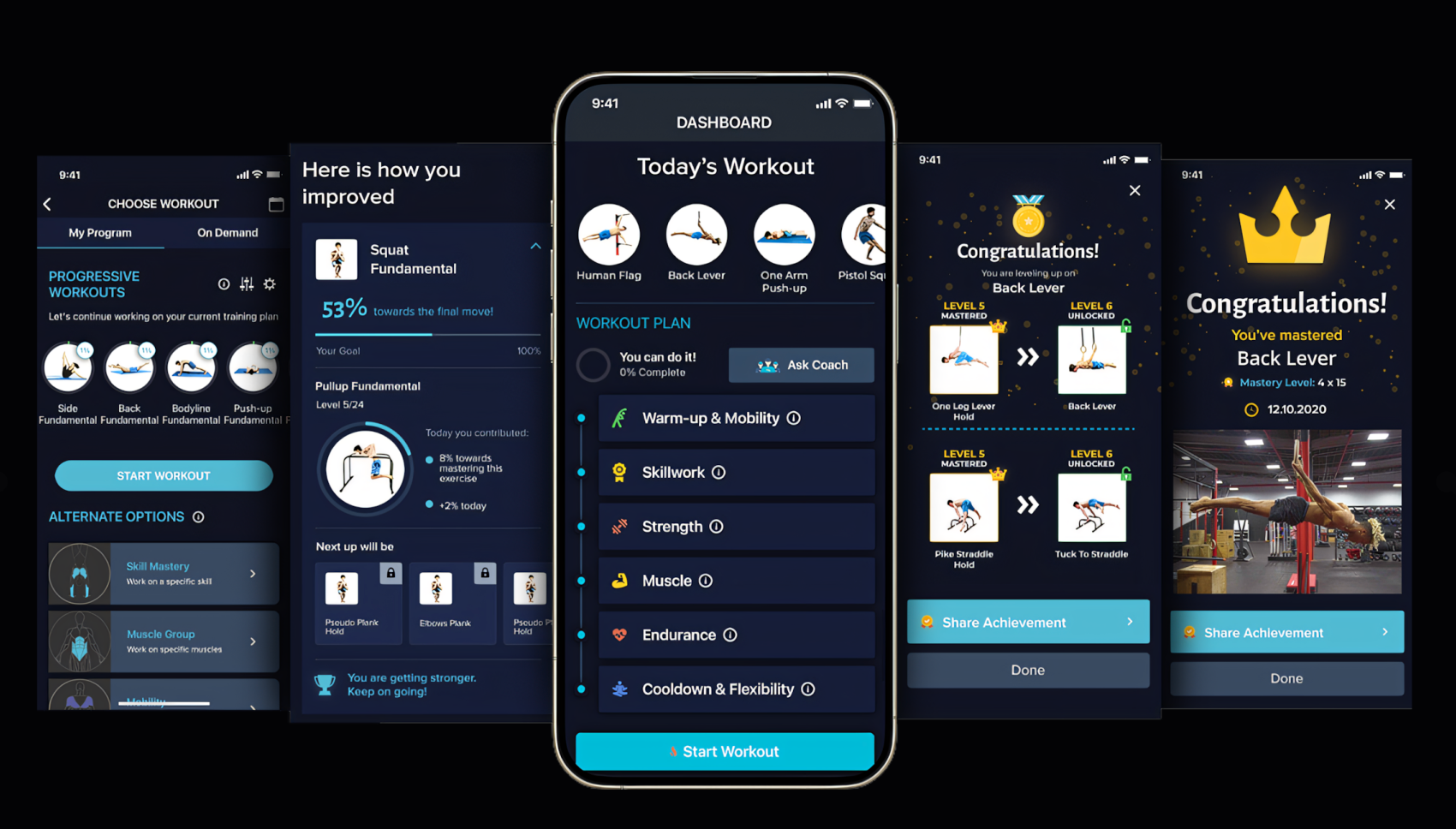
The 9 Fundamentals in the app — each with its own level, not one score for all of you.
Push-ups alone have a dozen levels — pull-ups more still. That’s 100+ progression levels in total across the nine — which is the whole reason this can tell you where you stand instead of rounding you off to one of three buckets.

One of the nine: the push-up ladder. Your level unlocked, the next steps waiting.
How it works — from 3-minute assessment to your first workout
We’ll tell you exactly what to do, so you can focus on your progress:
Take the athlete assessment
Answer questions about how you push, pull, hold and squat — plus your goals and anything your body’s been through. About 3 minutes, no equipment, nothing to perform in front of anyone.
Review your results
See exactly where you stand: your level in each of the 9 Fundamentals, your strongest foundation, and the one that’s limiting the rest.
Get your personalised game plan
Your exact sets and reps, set from your levels so you progress optimally — warmup and cooldown included. You never have to think about programming.
Train with smart, personalised workouts
World-class gymnastics and calisthenics programming, built by a team of coaches, physiotherapists and sports scientists — adjusting to how each session actually feels.
Keep unlocking new levels
Master one variation and the next unlocks — like a game. You always have a new target, and you can always see how far you’ve come.
Your result in the app: your current level, the exact variation you’re ready for, and what unlocks next.
Luke Murray · Movement Athlete member
“My workout is all laid out for me, but the thing I like most about it is the percentage thing — being able to see in real how close I am getting to my goals. I also love how it feels really personalized. It feels like you’ve got a personal trainer in your pocket.”
It finds where it’s safe for you to start
Whatever your history — a past injury, years off, or starting from zero — the assessment places you at the step it’s safe to begin, then builds up in small increments so your joints and tendons keep pace with your muscles. That’s the whole idea behind an assessment-first approach: the system meets you where you are instead of dropping you into an average person’s program.

A real placement: level 1 of 13 for dips — bent-knee bench dips — with the next steps locked until you’re ready.

Anthony Monte · Airline pilot
“I was just tired of aching all the time and feeling like I was losing mobility. … My hips and my lower back have stopped hurting, which has been great. What sold me on this app was that it has built-in algorithms in the AI to help you progress when you’re ready to progress.”

Jacques O’Connell · Physicist
“I have seen a really good improvement in my wrist flexibility. So, my wrists are much stronger, much more flexible. This increased my grip strength a lot. Also, my shoulders feel really good. … I can feel my body is getting stronger and more mobile as I’m doing these exercises, which it wasn’t when I was lifting weights.”

Kali Bennet · Movement Athlete member
“Love this program! … I don’t have to think about programming, it does everything for me including the warmup and the cooldown. … I’m seeing a lot of progression and I’m feeling more confident and more aware of my body.”
Calisthenics level assessment — FAQ
What does the assessment measure?
All 9 Fundamental movements in calisthenics — push-ups, pull-ups, dips, handstands, squats, abs, side, back and plank. Each is scored on its own, so you get a separate progression level for every movement instead of one composite score.
How long does the assessment take?
About 3 minutes in your browser. No timed exercises, no equipment for most of it, and your result shows immediately at the end.
Is it free?
Yes — the assessment and your results cost nothing, and there’s no card to answer the questions. If you want to keep going with the plan, there’s a 7-day free trial you can cancel any time.
Do I need equipment?
Not for the assessment. For the training that follows, most of the nine work with zero equipment at home — pulling is the exception, where you’ll want a bar or something solid to hang from.
I’m just starting out — is this for me?
Completely. Plenty of people start on the very first steps — wall push-ups, assisted squats, low-bar rows. The point is to meet you exactly where you are, not to grade you.
What do I get at the end?
Your exact level in each of the nine, the one foundation limiting the rest, and a personalised plan built from your levels — with the specific exercise variation that matches your ability today in every movement.
How is this different from a generic fitness test?
Most tests give you a single score. This places you at one of 100+ progression levels across nine separate movements — and because push and pull strength are independent, one number hides exactly the gaps that stall progress and cause injury.
I’m already strong — will it just tell me what I know?
Usually not. The nine run up to one-arm push-ups, muscle-ups and pistol squats, so there’s headroom above almost everyone — and strong lifters are exactly who this catches out, with big pressing numbers sitting on top of a pulling gap they’d never measured. Take the free 3-minute assessment →
You already train
This just tells you where to aim it.
See your level on all nine fundamentals, the one that’s holding the rest back, and a plan built from your exact results — the same system 100,000+ athletes train with.

Ross Lockie · Professional athlete & gym owner
“As a professional athlete I can say — the results are incredible. I’ve gotten a lot stronger on it. Plus, by not using weights I find, using bodyweight, I don’t have stress on my joints. … It works. I say that, as someone who’s been doing this a long time — the results are real.”
Prefer to skip straight in? Start training free →
Brought to you by The Movement Athlete — personalised, assessment-first calisthenics training.