Calisthenics Workout: The Best Full-Body Routine by Level
Updated July 2026
Written by the TMA coaching team · Reviewed by Jesse, Head Coach, The Movement Athlete · Updated July 2026 · 22-min read
Free · takes about 3 minutes
The best calisthenics workout is the one built for your level.
Most people train above their real level — that’s why it never sticks. The free 3-minute assessment finds yours across all nine fundamentals.





Example placement — the free assessment finds yours across all nine fundamentals.
Want to get in shape without equipment — and keep your joints strong for years? Calisthenics is hard to beat.
It builds muscle, strength and endurance while burning calories, using nothing but your body weight. You can train anywhere, and it costs nothing.
The best calisthenics workout isn’t a single routine — it’s the one matched to your current level across the nine fundamental movements.
- Six patterns, one session. Horizontal and vertical push, horizontal and vertical pull, core, and legs.
- Progress by difficulty, not weight. The Movement Athlete maps these across 100+ progression levels, so each step is about 5–10% harder — and tendons adapt alongside muscle.
- At three days a week, full-body beats splits. Every pattern is trained often enough to build real skill.
Below is a complete routine you can start today with no equipment — plus how to find your exact starting level.
Key takeaways
- The best calisthenics workout is the one matched to your current level across the nine fundamental movements — not a generic template.
- Full-body sessions about 3× a week beat body-part splits for most people.
- Progress comes from harder variations (progressive calisthenics), not endless reps.
- The routine below assumes ~15 pull-ups, 20 push-ups and 25 squats — scale it to your level.
- A free 3-minute assessment finds your exact starting level on every movement.
On this page
But… the biggest mistake people make is thinking that doing any bodyweight exercises will get them the results they want.
Nope!
In this article, we will explore what makes the best and most effective calisthenics workout programs.
We will show you elements to look for, based on decades of experience and training thousands of people over the last 10 years.
We will answer all your questions about reps, sets, progressive resistance, and how to create your own training program that is optimized for building strength and losing fat at the same time.
But all the more, we want to show you how powerful calisthenics can be when used as a part of structured & progressive training – an approach called adaptive calisthenics.
Let’s go!
What the Best Calisthenics Workout Can Do for You
Calisthenics is an old art of building strength used by warriors in ancient times and has so many incredible benefits.
Here are just some benefits that some of our 100,000+ users experienced just after a few weeks of training with TMA Academy.
Build lean muscles and lose fat naturally
“My physique changed hugely, now have a six-pack my core is very strong, shoulders and my torso has grown quite a bit.” – Sean
No more joint pains and muscle aches
“Some knee pain that I have from time to time is also dissipating.” – Taha
Improved mobility & flexibility
“My mobility has improved significantly. I finally can touch my toes, my hamstrings are not tight anymore and finally can lift my kids without pain” – Matt
Functional strength
“I have developed a surprising amount of strength and I just feel so much healthier and more energetic after starting the program.” – Michael
Confidence & feeling my best self
“I feel more confident, my disposition is bigger, I feel more calm and relaxed. My humor is better. Now, I have better physical conditioning and my muscles grew. I have much more strength.” – Wagner
Better posture
“The first change that I noticed was the fact that my posture improved. I felt like I became taller, which in turn made me more confident.” – Taha
Mentally stronger
“My pain threshold has dramatically challenged and I believe that is a fundamental shift in my mentality. I can keep going with my workouts a lot more than before.” – Matt
More energy and younger than ever
“I am full of energy, get lots of compliments, and my gym hired me as a personal trainer so I could be a role model for their 60+ [years old] members.” – Carol
Stress-free workout
“My life has gotten simpler in terms of training when I can rather than stressing about not making the gym/ scheduled workouts.” – Phil
Always motivated & excited to train
“Mentally, I’ve started getting used to working hard, and have really made an effort to take my time during each exercise.” – Liam
I am having so much fun
“It’s like a game, with levels and all that, so that was a bit exciting, it was very interesting to see.” – William
You can read more about the results from our users here:
What happened when 30 ordinary people tried calisthenics
What results can you get when you start training with calisthenics?
These people did not get these results but doing some random bodyweight exercises.
There are plenty of articles out there giving you 8 weeks of ready-made workouts promising crazy results. Don’t get me wrong any exercise is better than none. But they won’t get you the results you are after.
The key to making calisthenics effective is
- Ever-changing progressive resistance
- Personalization
- Autoregulation and ongoing reps and sets adjustment
How to Recognize the Best Calisthenics Plans Available Online
If you’re looking for one of the best calisthenics workouts that can help you achieve your fitness goals, you’ll be happy to know that there are a few of them available online, and most of them are pretty good.
We actually compared all of them here
The best-personalized plans are not 8 weeks programs, but they leverage technology to provide a personalized and adaptive approach to your fitness.
So…
What are the elements of a successful calisthenics training program?
Holistic approach
A complete workout regimen is made up of muscle and strength building, mobility, flexibility, endurance, muscle building, skill, and balance elements. So if you see simple linear strength progressions and no programming for building skill, endurance, mobility, or muscle – run
Because everyone’s different, it’s hard to progress effectively without personalizing the approach. Cookie-cutter workout routines that give you a ready-made structure with reps and sets will just hurt yourself and your goals. Differentiating beginners from intermediates from advanced training will still have gaps in training.
This is the exact problem the assessment solves.
Cookie-cutter routines fail because they don’t know your body. The free assessment measures where you are on each fundamental movement — push, pull, squat, core — and builds your plan from your actual level, not an average. It takes about 3 minutes.
Take the free 3-minute assessment →
“TMA is the first one that actually has a real system and adapts to where I am.” — Raya, TMA member
The 4 elements every real calisthenics program trains
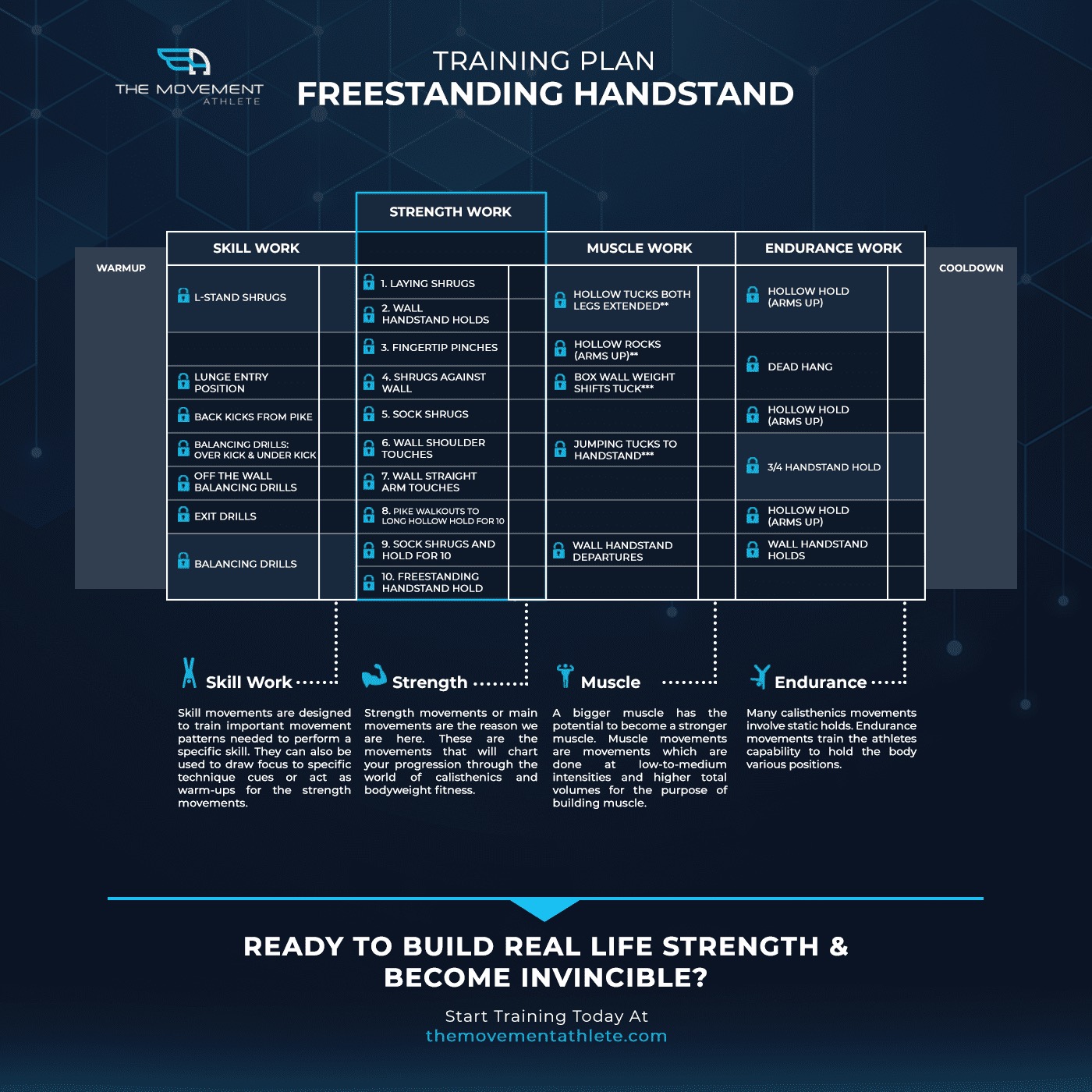
Calisthenics is not just brute strength. When we build a training program for any skill, we always train four categories together:
- ✅ Skill work — technique first. Mastering movement patterns and specific cues lays the foundation everything else stands on.
- ✅ Strength work — the bread and butter. These movements chart your progression, with reps and sets optimised for building strength.
- ✅ Muscle work — targeted movements at higher volumes, because a bigger muscle has the potential to become a stronger muscle.
- ✅ Endurance work — holding positions is no joke. We train your ability to hold your body in various positions, building resilience.
This is exactly why generic bodyweight routines fail: they hand you push-ups and squats with no progressive resistance and none of these elements in balance — so you plateau, or you get hurt.
So how should the best training program actually look? Like this — a real TMA training plan for the freestanding handstand:
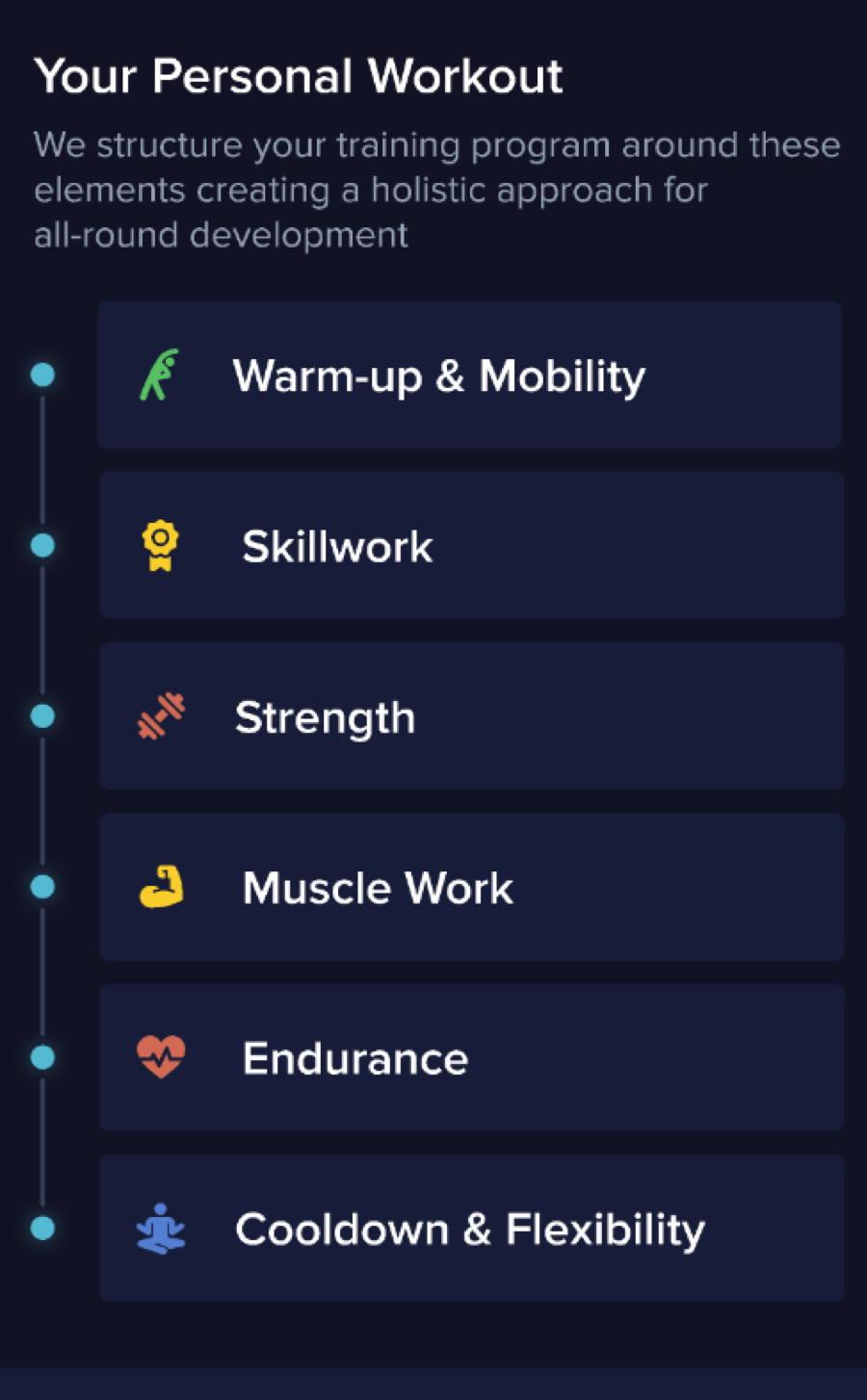
And this is how the same structure appears inside the app — every daily workout runs warm-up & mobility → skill → strength → muscle → endurance → cooldown & flexibility:
But, the biggest problem with the one-size-fits-all training routines is that they either
1. Promoting Compensation, Movement Dysfunction, and Possible Injury Risk If Too Challenging
2. Not Promoting Adaptation/Development If Not Challenging Enough
So why on earth are we are still not personalizing these workouts?
The truth is that: IT’S EXTREMELY HARD and this is why want to employ current technological advancements to help with that
Read more here: Why personalised calisthenics
- Effective progressions + Ever-changing progressive resistance
A well-designed program includes a series of progressions that start at your current level and take you to the next one. These increments are made up of varying difficulty aimed at all aspects of your body, but for it to be effective your body needs to be exposed to ever-increasing progressive resistance.
There are many ways to manipulate resistance from increasing reps and sets, adding weight, changing the angle of the movement – you can read more about it here. Ideally, you would increase resistance as you see fit but it can be hard and confusing without the trainer.
Again, technology is here to help and it should bridge every gap in a progression by addressing the needs of an individual and making sure you’re progressing at a rate that’s sustainable over time.
Professional support + video-based exercise demos
There are times that you will need some answers to your questions regarding your technique, the training structure, or anything under the sun regarding your fitness journey. It should offer professional support to your inquiries so you don’t get confused or stuck in your journey.
Community & progress visualization
Finding others who are interested in calisthenics will not only help spur you on but also offer moral support when the going gets tough.
Alongside this, it can be very discouraging to work out without seeing any progress for weeks and months on end. A successful calisthenics program offers a visual representation of your progression so you always know what’s coming next or how far away that goal actually is!
The right mindset
Calisthenics exercises, or any other approach, will not get you immediate results overnight or even in two weeks. Fitness is a lifestyle and takes a lifetime of effort and commitment.
The mistake other make is that they try to sell you a workout plan as if it will happen overnight or over a short period of time.
That doesn’t mean calisthenics is slow, but the results come in a more realistic way and there’s no need for any outside help or supplements like other programs might require.
Push yourself and commit to sustainable exercise practice.
These might seem like small things, but they make the difference between someone who’s trying to scam you and someone who actually cares about your well-being and your health, helping you not only to grow as a person but also to achieve your dreams.
How the Best Calisthenics Program Is Structured
Introducing The Movement Athlete (TMA), a calisthenics app that’s aimed to help you build muscle, strength, mobility, and bulletproof joints for life!
The program offered by The Movement Athlete is the best calisthenics workout with structured learning that takes you from Point A to Point B in a matter of weeks, without leaving you hanging for more information or more knowledge. The program meets six crucial elements that help people progress in their fitness journey.
It follows these four steps for a lifelong calisthenics and fitness journey.
Step 1 — Assessment: find your exact level
Before anything else, we measure where you actually are — on every movement, not a generic label.
This is a crucial step to establish your actual level of fitness and capabilities for exercises and skill work. Assessment opens the opportunity for the program to be personalized and tailored to your needs.
A beginner is different from another beginner. Even though they might generally start from the same level, each has his or her own strengths and weaknesses. A proper assessment sets a baseline so you can make clear progress while also ensuring that your journey runs efficiently and safely.
Step 2 — Your personalised plan & workout routines
Your assessment becomes a plan built for those exact levels, not a template.
Based on your assessment, the app creates a personalized training program just for you.
The workouts are easy to follow and unlike other apps, they are optimized for strength training, fat loss, muscle building, skill & endurance by including varied rep schemes every time you workout.
As this is ADAPTIVE CALISTHENICS our workouts will adjust in real-time based on your feedback and increase resistance as you go along.
The app also adjusts to how much time do you have by splitting your routines when you have less time and creating a full body workout if you have more time.
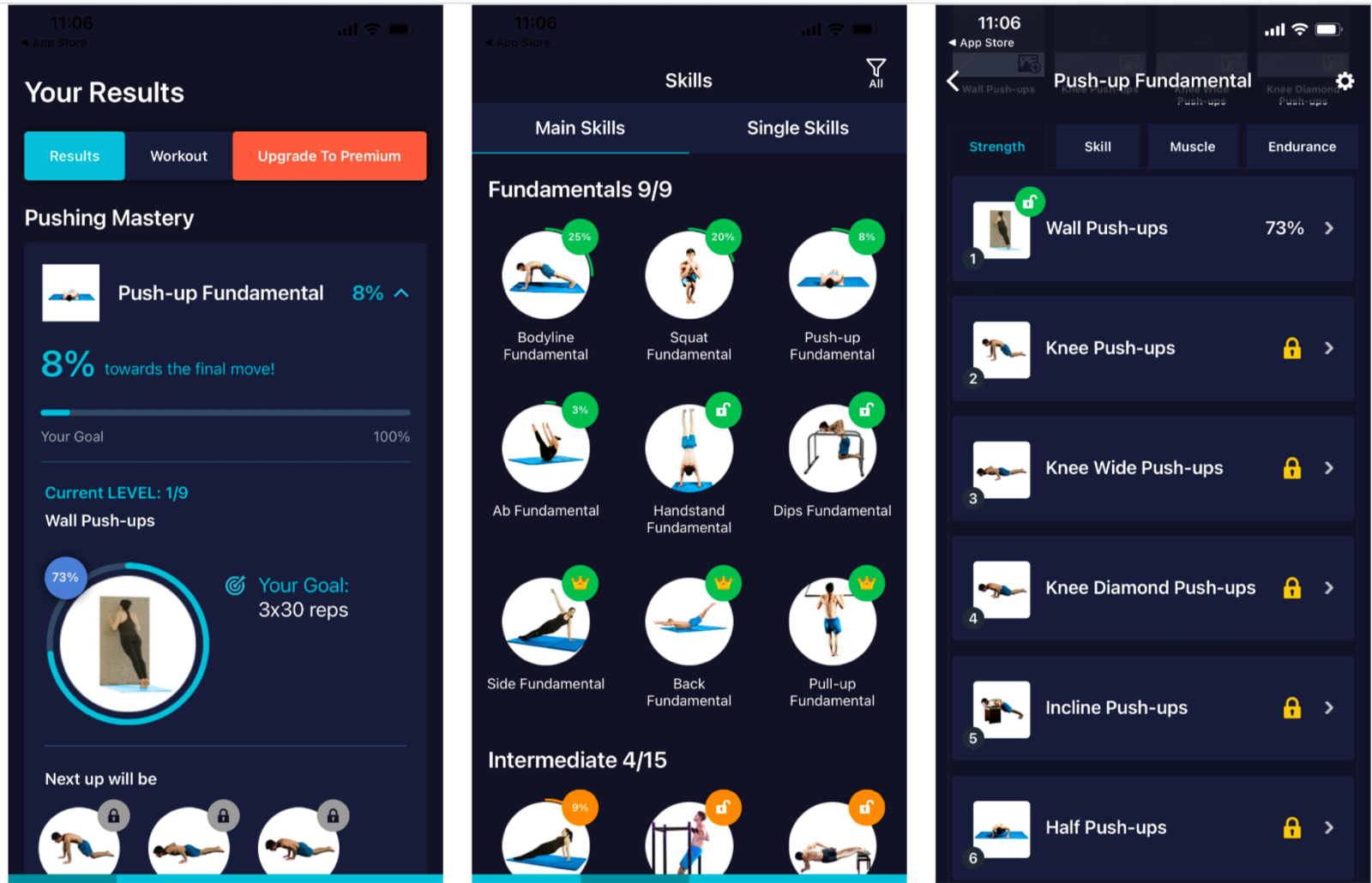
Step 3 — The mastery system & skill structure
You climb a structured skill tree — fundamentals first, advanced skills as they unlock.
Fundamental Skills
If you are a beginner you will most probably end up somewhere on our fundamentals. Which are:
Pushing
- Pushup Fundamental
- Dips Fundamental
- Handstand Fundamental
Pulling
- Pull-ups Fundamental
Legs
- Squat Fundamental
Core
- Side Fundamental
- Abs Fundamental
- Back Fundamental
- Bodyline Fundamental
The 9 Fundamentals
100+ progression levels across the 9 fundamentals.
The assessment finds your exact level on each one.
Push · Horizontal
Push-Ups
Push · Vertical
Dips · Handstands
Pull
Pull-Ups (incl. rows)
Core
Abs · Side · Back
Bodyline
Plank
Legs
Squats
If you’re new to calisthenics, your first goal in this phase is to establish a strong and solid foundation for future progression. We do that by learning the fundamentals with their associated muscles and motions such as push and pull.
Advanced skills
If you are a more advanced athlete, the assessment will show you the exact level you are at and the harderskills that you can start working on already. The moves, such as planche training or pistol await those who have mastered the fundamentals.
When you’re ready to move on from beginner skill training, you’ll begin to achieve better progress due to the high demands of high-level skill work. It’s a combination between strength training but using bodyweight and if offers more than just one way in which your physique will develop.

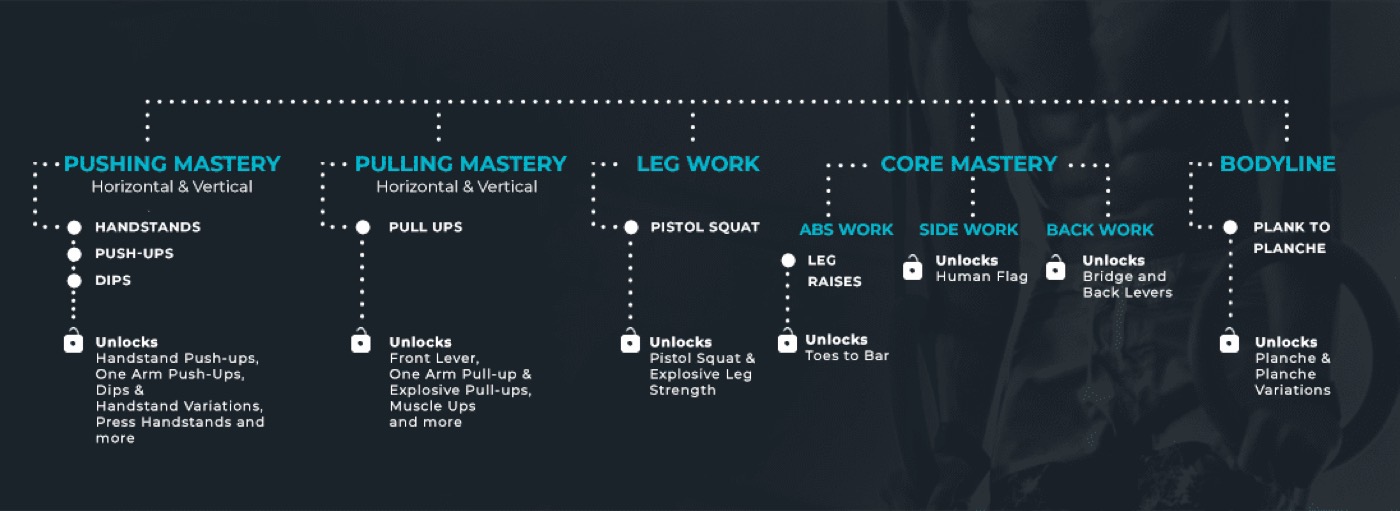
There is a structure to what you should work on — we call it the fundamentals. They are the basis for every advanced calisthenics move, covering your full-body strength and mobility to prepare you for the next level: pushing mastery (vertical & horizontal), pulling mastery, leg work, core work (abs, side and back) and bodyline.
So where should you start? NOT at step 1.
Hardly anyone actually starts at step 1. For training to work it must be challenging enough that your muscles adapt — but not so hard that you get injured. This is where the whole “beginner / intermediate / advanced” idea quietly hurts people: it is just not personalised enough.
That is why TMA starts with a comprehensive assessment: it finds where you are on each progression — your push-up, your dips, your pull-up, your handstand — and builds a truly personalised program around those exact levels. It gets granular: Push-up — step 5. Handstand — step 6. Dips — step 10.
Pull-up — mastered, one-arm pull-up unlocked. And it should get that granular — a generic program risks wasting your time at best and injuring you at worst.
What is a progression?
A progression is a roadmap — a series of exercises that get harder step by step, guiding you toward a skill like levels in a video game. Each step you master unlocks the next challenge. Here is the whole journey toward a freestanding handstand:
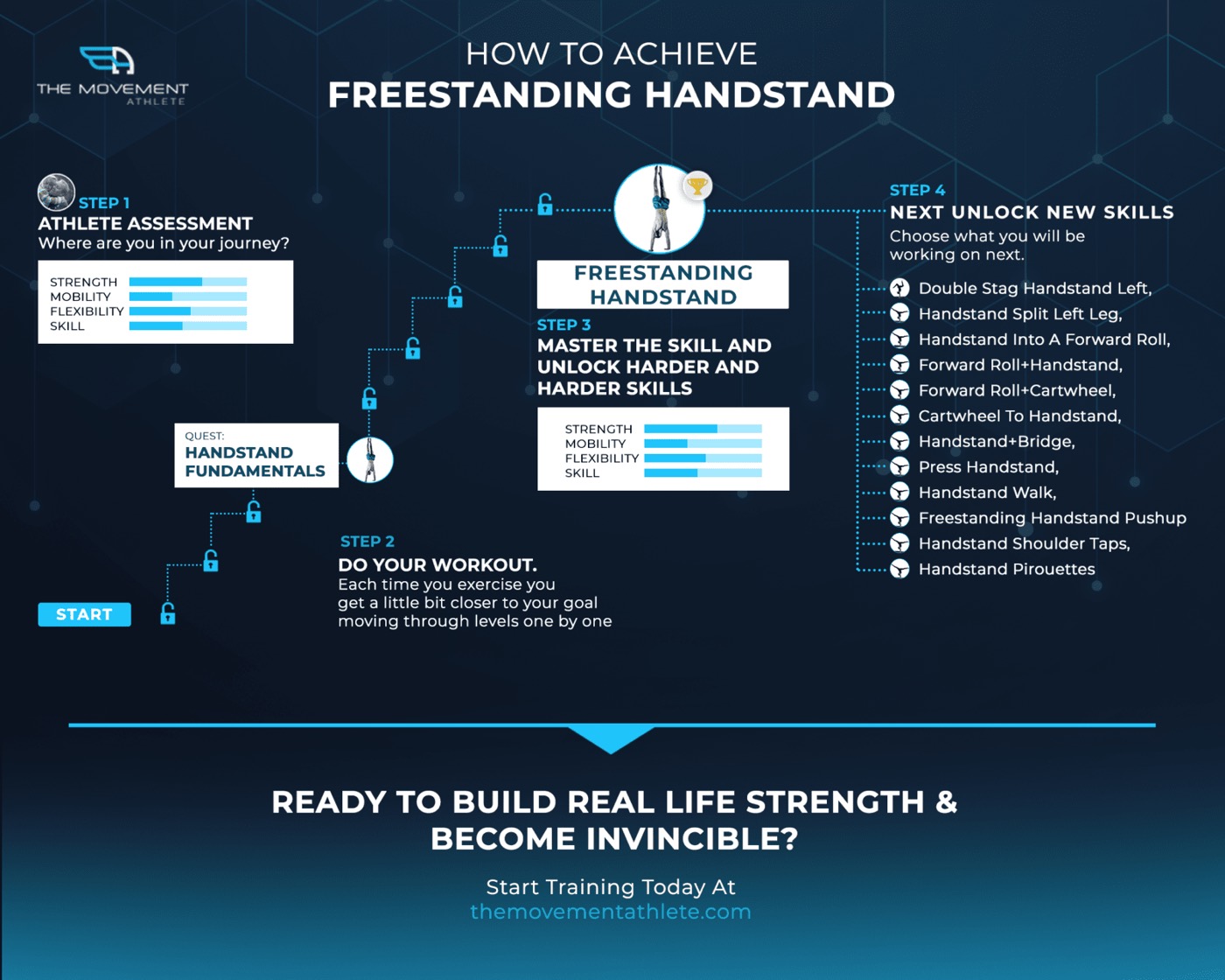
Step 4 — Advancing: a lifelong journey of bodyweight mastery
There’s always a next step. The system keeps giving you the right one, for years.
TMA follows a gamified mastery system that guides you from fundamental skills to more and more advanced ones. As you go along you will be mastering and unlocking new skills. The system is designed to in the safest way take you from safely from your first rep to genuine strength.
How to ensure progress with calisthenics training?
Progressive overload is the term used to describe the idea that you need to continually challenge your muscles and structures with new exercises in order to progress.
New exercises are added through a variety of methods, such as position changes or modified range-of-motion (ROM) movements; inserting adds reps into an exercise progression scheme; or more.
If you want to make progress, you have to perform better for progress every day or at least every week.
Adaptive calisthenics
There are many factors you might need to consider in order to progress in your training which is why The Movement Athlete developed an adaptive training program that adjusts so you can improve while still factoring in other vital elements outside of your training such as your energy levels or mood.
Let’s face it, we can’t train 100% every day because we have other responsibilities in our lives other than our fitness. Adaptive training through The Movement Athlete helps you continue to improve even when feeling low.
While still applicable to some degree, online platforms like the one offered by The Movement Athlete are definitely the future (and present) of calisthenics workouts. It’s super easy to tap in and start working on yourself this way, without encountering physical barriers that would prevent you from realizing your full potential.
How long should you train enough to see results?
A calisthenics workout is the best kind of exercise because it uses your bodyweight to build strength and muscle, which means you don’t need much equipment to push yourself to the limit.
With the right training program, you will see results with calisthenics in less than 15 min 3 times per week. The key to an effective training program is constantly increasing progressive resistance.
That’s why it’s extremely important to take an assessment and know exactly what exercises to do to achieve that happy spot where you are challenged but not getting injured.
The other important aspect to keep in mind is making sure that you are hitting all the important muscle groups including upper body like chin-ups, press-ups, dips; core through exercises like hollow holds, planks, and back as well as legs.
We have seen incredible results people achieve when they follow a personalized calisthenics regimen that includes workout plans adjusted to exactly where they are at and focuses on a holistic approach.
What calisthenics equipment do you need (Pull up bar, dip station for leg raises, push up handles etc)
Although calisthenics can be done without equipment, certain calisthenics equipment will make the exercises more efficient and effective.
The essentials calisthenic equipment are
- pull-up bar
- dip stations for push exercises
- set of resistance bands
- gymnastic rings to perform different upper body exercises
- wall for handstand and building body alignment
- Box or higher surface for squats and leg exercises
These pieces of equipment are not mandatory, but they will open your workout plan to more calisthenics exercises that will help you progress faster especially for beginners.
You can use the pull-up bar to do both chin-ups and dips. Dip stations are for the obvious motion and other exercises that might need parallel bars, while gymnastic rings allow for more advanced calisthenics exercises by incorporating the element of instability into an exercise and “isolating” arms, chest, shoulders, or other specific groups.
Resistance bands are excellent for bridging gaps by adding assistance or can also add difficulty to an exercise.
As much as possible, you would want to get your hands on these gears. Don’t worry, they’re very much affordable and accessible. If not, you can easily find alternatives in your surroundings.
ULTIMATE FULL BODY WORKOUT
Level
Free download
Want a plan for the next 28 days?
A free structured challenge — what to train each day, scaled to where you are now.
Free · straight to your inbox · no card.
Time
Goal
Intermediate
75 minutes
Fat Loss
About this Calisthenics Workout
Here is an example of a calisthenics workout that uses fundamental movements covering the entire body.
Note that this is an example of the workout, If you want to get a personalized training plan for free click here.
It’s structured as circuit training which simply means that you have to move from each exercise with little to no rest. After the last exercise, you have completed one round then you can take a longer break period for recovery.
We also attached a video of each exercise so you can follow along and know exactly how to perform the exercise given. Never forget the basic golden rules when performing every exercise
The main focus of this workout is fat loss while strengthening fundamental movement patterns and it’s great for beginners. This will make it easier for you to pursue higher-level skills in the future.
But the benefits don’t stop there! Since you’re going to train with high volume with enough intensity you could still lose fat while building strength and developing muscle mass with the training. This holds true especially with the proper diet and caloric intake.
The exercises in the routine are arranged as such so each muscle group won’t be fatigued as much when doing the circuit. This is an excellent way to make gains while cutting your training time by lessening your rest periods.
Never forget the basic golden rules when performing every exercise
What exercises should you be doing?
Trying to create your own training can be extremely confusing.
There are so many questions like,
- How do you perform proper leg exercise that builds strength?
- Should I be doing planks with elbows on the floor or keeping my knees on the ground?
- Can I jump right into the workout?
- Is the training safe and effective for beginners?
- Will bar chin-ups, get me injured or should I do exercises on the rings?
- How to incorporate jump into my routine?
- Will it grow my chest?
- Should I do a circuit or straight sets, should I have a 30 second or 60-second break?
- How can I add weights to my bodyweight exercises?
- I’ve heard that leg work is limited, what exercises & weights should I use to train my legs.
- Do I need a gym?
- Will my knee start hurting?
This is why so many people give up so quickly on their bodyweight journey and this is why we created a comprehensive training that starts with an assessment so you know exactly where you should be starting.
The honest answer to most of these questions is: it depends on your level — and that’s exactly what the free 3-minute assessment works out. It measures each fundamental movement and tells you where to start, what’s safe, and what to progress next. Take the assessment and get your answer →
While you can do a free assessment here in this article we will show you an example of a workout that someone who is working through their fundamental movements would do.
Note that when you use the TMA app, you don’t have to think about the rep range or sets, which exercises you need to do. It’s all prepared for you with the video instructions. So all you need to do is to show up and push yourself.
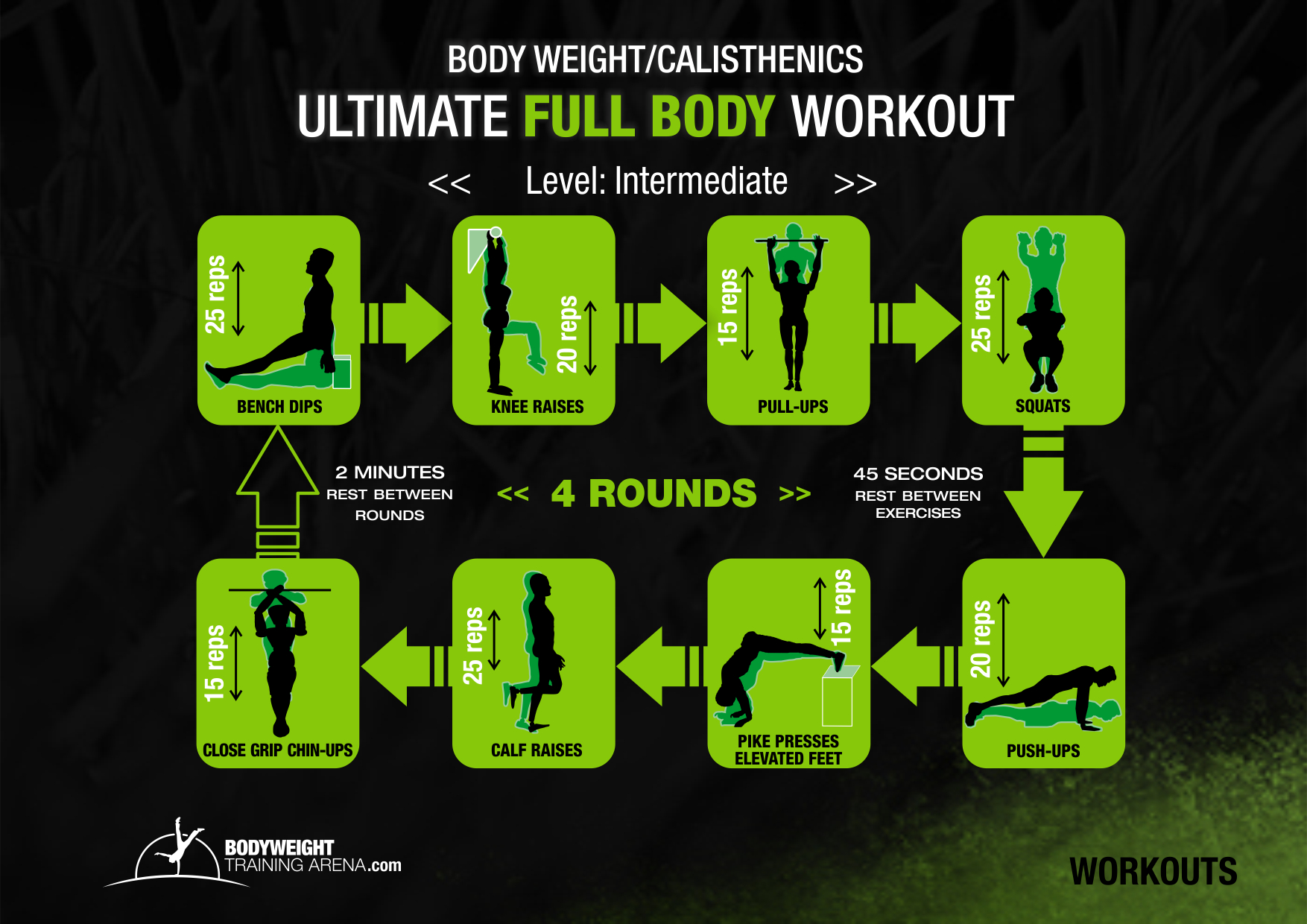
Remember — don’t copy this at step 1. Scale every exercise below to your assessed level.
Below is the generic version everyone starts with — solid, but built for nobody in particular. Use it today, then get the version calibrated to you.
| Move | Sets | Reps |
| Bench Dips | 1 | 25 |
| Knee Raises | 1 | 20 |
| Pull-ups | 1 | 15 |
| Squats | 1 | 25 |
| Push-ups | 1 | 20 |
| Pike Presses Elevated Feet | 1 | 15 |
| Calf Raises | 1 | 25 |
| Close Grip Chin-ups | 1 | 15 |
Rest for 45 seconds between each exercise and rest for 2 minutes for each round. Total of 4 rounds.
Before you try this routine — a quick reality check.
This workout assumes you can already do 15 pull-ups, 20 push-ups and 25 squats — then repeat the whole circuit for 4 rounds. If that’s above where you are today, you’ll grind and stall. If it’s below, you’ll coast. Either way you leave results on the table.
The free 3-minute assessment finds your level on each of these movements and gives you this same style of full-body workout, calibrated to you.
Get this workout at MY level →
“The progressions are smarter than anything my old PT gave me, my lower back pain is basically gone, and ive stuck with it longer than any gym membership ive ever had.” — Mark, TMA member
How It’s Done
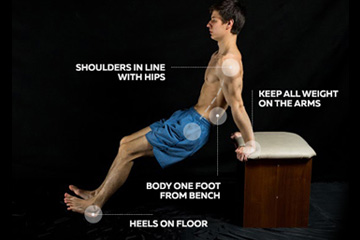
Dips (vertical push)
Target: triceps, lats, shoulders, chest
8-12 reps
Coaching pointers:
- Elbows tucked close to waist
- Lower to 90 degrees or more
- Straight lockout at the top position
- Shoulders fully depressed even as you press up
If you want more forearm exercises click here
Easier Variation: Band assisted variation, leg assisted, negatives
Harder Variation: Ring dips, weighted variation
If you want more forearm calisthenics exercises click here
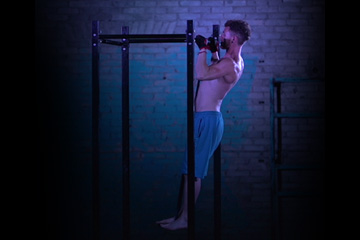
Pull ups
Your biceps and back workout monster. Keep the form in check in each repetition. Do not force your neck over the bar just for the sake of “getting over the bar”. Always perform the exercise in a controlled manner, even when performing explosive pull-ups. We don’t want any loose momentum.
And when performing the exercise, imagine driving your elbows to your waist to get the lats going!
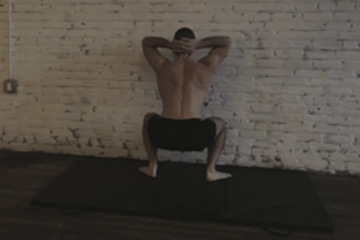
Squats
Train your quads, hamstrings, and glutes with squats. Just remember the key points when performing the movement. Do not let your knees move past your toes. Control the concentric and eccentric movement. The wider your stance, the more glute activation it gets, just don’t over do it. Straight body line is must. Always.
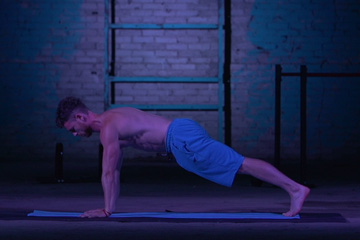
Push ups
We all know what the push-ups are for; shoulders, chest, tricep and even core. But how it’s PROPERLY done? Have a straight body line. Do not let your elbows flare out to the side. Keep tucked inwards or parallel to your body.
Focus on contracting the main muscle groups in motion to get the most out of the workout.
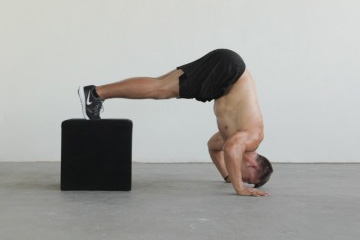
Pike Presses Elevated Feet
This is exercise prepares your shoulders for the upcoming handstand push-ups in your future! Like every exercise, slow and controlled. And like every push-up, do not let the elbows flare outwards to prevent nasty unwanted (who would want in anyway) injuries. Keep a straight back when performing and keep your head in a neutral position.
Calf Raises
Calf muscles are an important muscle group when generating power from your legs so have to train them with raises. When performing the exercise, do each leg one at a time to correct possible muscle imbalances and practice your balance.
Be sure to equally reach the peak of the movement for each leg and every set and rep.
Close Grip Chin ups
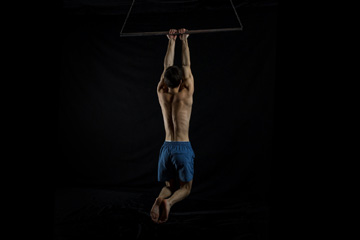
Finish the workout round with a biceps building exercise. The pointers you have to keep in mind for this exercise is basically the same as the pull-ups; but instead of driving your elbows to your waist, you have to imagine driving them to the ground down. This provides more bicep activation and lower back activation.

Real members, real 30-day changes — every one started at their own measured level.
Is it OK to train every day?
Training with body weight every day is possible, but should be done intelligently.
For full-body workouts, it’s best to allow 24 to 48 hours of break to achieve maximum recovery.
If you want to train every day, you can do split workouts to give other muscle groups a break while you work on a different body part. Allot at least 1 rest day if you can. You can also make it an active rest by adding a light mobility session or jog during the day.
For beginners, training 3 to 4 times per week should be plenty enough.
You can read more about it here
Can bodyweight training build muscle mass?
Yes, and here’s why:
- Focus on compound movements for multi-muscle stimulation
- Progressive overload using progressions
- Complex movements for higher-level strength gains
- Leg muscle gains using isolation movements and bodybuilding principles
- Using your body weight can still overload with the right progressions
- As body weight increases, exercise gets harder, you get stronger
If your main goal is to build muscle mass (even if you’re training with bodyweight or lifting at the gym), you need to satisfy these three elements:
- Progressive overload in your bodyweight training
- Proper nutrition through whole foods and suitable caloric intake
- Recovery with good sleep and stress management
The ULTIMATE Calisthenics Workout Program Ever Made
To end this article we want to emphasize that the best bodyweight workout routine ever made should be personalized both for maximum exercise benefits but also to not get injured.
We found TMA to be the most comprehensive, safe, and personalized training program out there. Beginners, intermediates, and even advanced athletes can get the best workout at a tap on a mobile device and start getting a strong & mobile body.
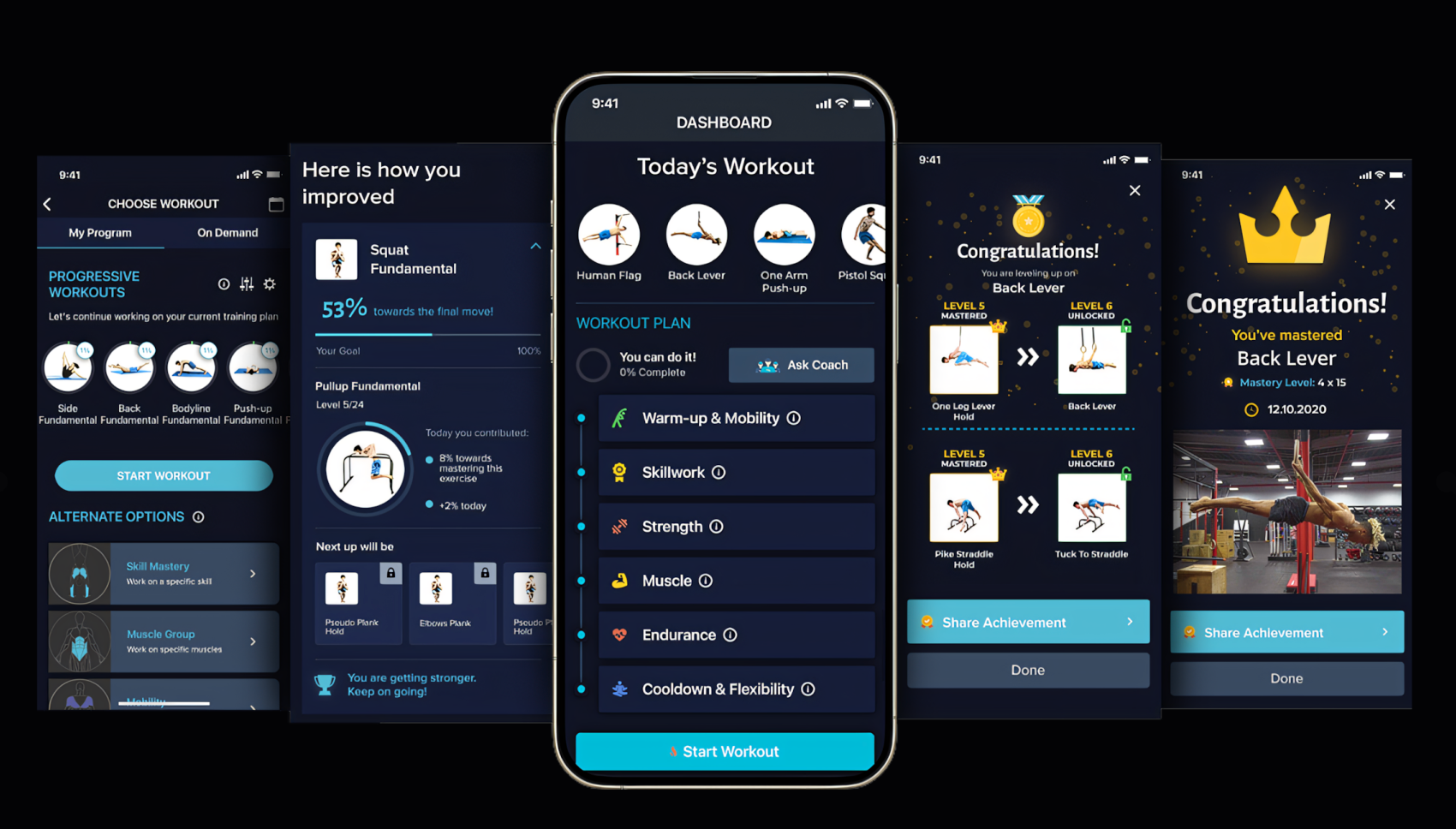
Over 100,000 people are already using it, and you can see what they have to say here.
Joining is extremely easy. You can immediately begin with the FREE ASSESSMENT at the end of which you will get a personalized training routine and free workouts to get you started.
Thanks to the multi-layered platform that’s available on all major operating systems, and no matter whether you are a beginner or you have done exercise for years, you can use the TMA app anywhere, however, you want, no equipment necessary. It’s the most flexible fitness regimen in the world and, best of all, it works.
Who is behind this ultimate calisthenics workout program?
TMA training system is a result of a collaboration of 10 different coaches including gymnasts, calisthenics & street workouts pros, physiotherapists, and sports scientists over the last 4 years (!!!).
This is not just a single trainer imposing his views on you, but a team committed to constant research and improvement of our system, based on empirical results that we get from you guys.
This team is also backed by the world’s best Sports Tech Startup Accelerator run by the Adidas family and ex-Redbull executives – so you can be sure that they are here to innovate and deliver an incredible product.
That means better workout plans for you and a fantastic tracker that you can follow at any point in time. You won’t regret taking part in the best calisthenics workout app ever made.
Sign up right now and try the FREE assessment so you can begin your personalized training!
Stay strong, everyone!
The community
100,000+ real people, training to their own level.
Ordinary people — every age, every starting point. No models, no staged transformations.

Your next step
Stop guessing. Train with a plan built for your body.
Take the free 3-minute assessment, see your exact level on every fundamental movement, and get a personalised calisthenics plan that progresses as you do — the same system 100,000+ athletes train with.

“This program has allowed me to rehabilitate my shoulder to where it’s now asymptomatic with full range of motion.”
— Wayne, TMA member
“I bought this YEARS ago, at full price, and it is still worth every penny.”
— Caleb, TMA member
Prefer to look around first? Start training free in the app →